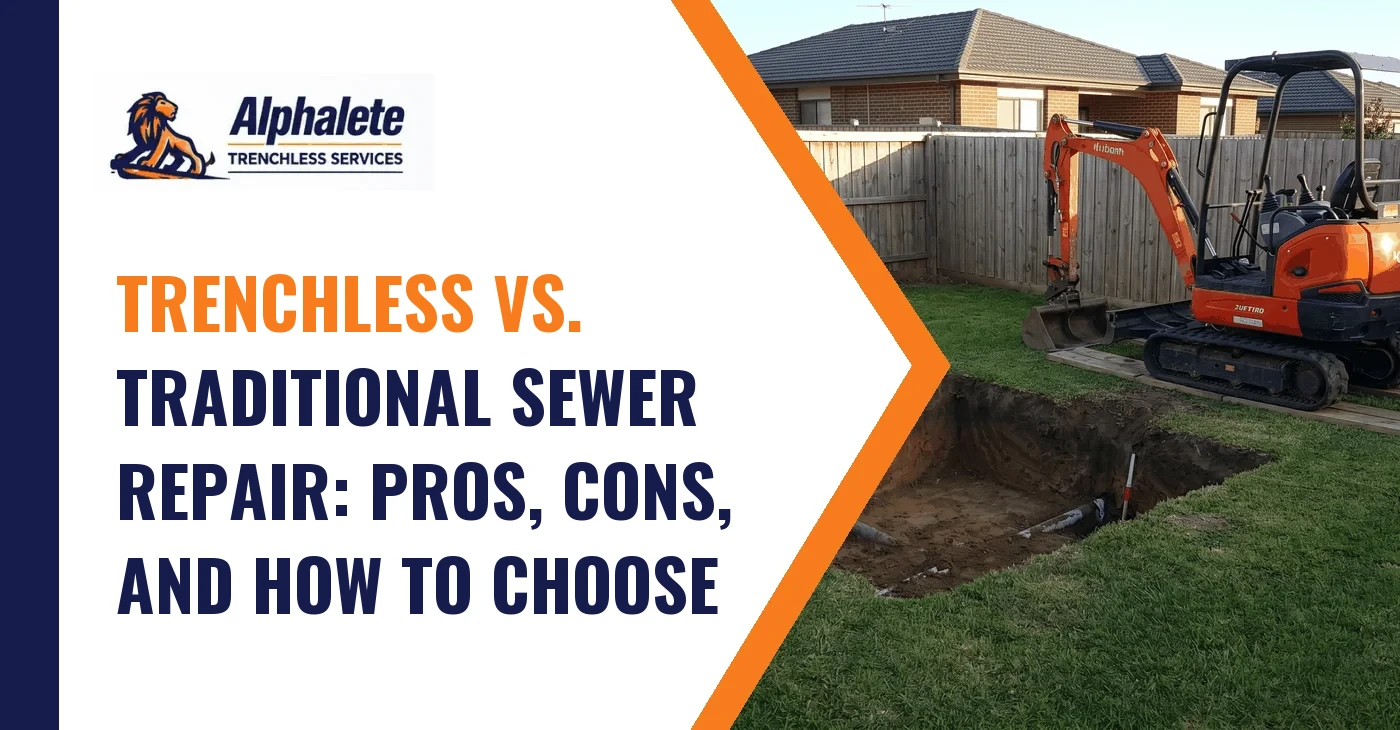
Trenchless sewer repair fixes a damaged sewer line from the inside through small access points, while traditional sewer repair digs a trench to expose, remove, and replace the pipe. Trenchless repair is usually less disruptive and often faster. Traditional excavation is the right call when the pipe has collapsed or has to be regraded. Which one your line needs depends on its condition, not on preference.
This guide compares trenchless vs. traditional sewer repair side by side: how each method works, the real pros and cons, what drives the cost, and how Colorado soil and older Front Range homes affect the choice. If you want the background on the no-dig approach first, start with our guide to what trenchless sewer repair is and how it works.
Trenchless vs. Traditional Sewer Repair at a Glance
Factor
Trenchless (no-dig) repair
Traditional (dig-and-replace) repair
How the pipe is reached
Through a cleanout or small access pits
An open trench along the damaged run
Surface disruption
Minimal; lawn, driveway, and landscaping mostly stay put
Everything above the pipe comes out
Timeline
Often shorter, with no trench to dig and refill
Longer, with excavation, backfill, and restoration
Pipe condition required
Line must still hold its shape (for lining)
Works on any condition, including full collapse
Fixes a sag or bad slope
No, lining follows the existing path
Yes, the line can be regraded
Restoration afterward
Little to none
Sod, concrete, sprinklers, and plantings to replace
End result
A new structural pipe inside the old one, or a new pipe pulled into place
A brand-new pipe in a new trench
How Does Traditional Sewer Repair Work?
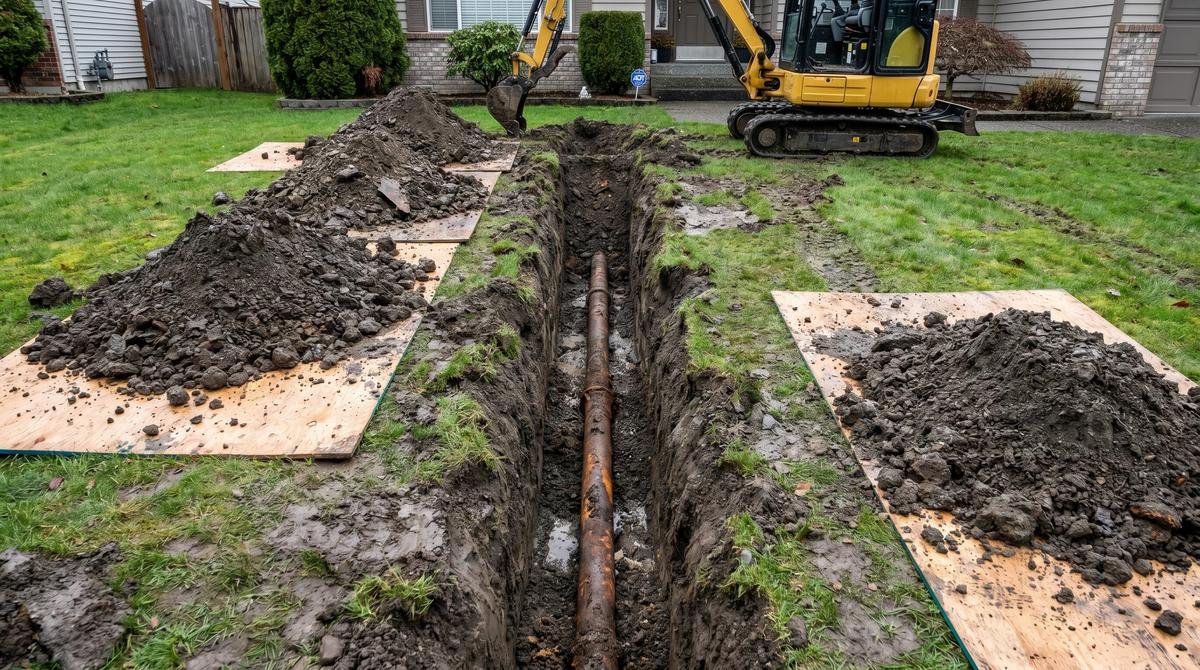
Traditional sewer repair, also called open-trench or dig-and-replace repair, removes the soil above the damaged pipe so crews can cut out the failed section, or the whole run, and set new pipe in its place. Anything on top of the line comes out first: grass, landscaping, sprinkler lines, and sometimes sections of driveway, sidewalk, or patio. After the new pipe is inspected, the trench is backfilled and the surface is restored.
Dig-and-replace restores the pipe but takes the surface with it.
How Does Trenchless Sewer Repair Work?
Trenchless sewer repair works through existing openings, such as a cleanout, or one or two small access pits instead of a continuous trench. It starts with a sewer camera inspection to confirm the pipe is a candidate, then hydro jetting to clear roots and buildup. From there, one of two methods is used:
Pipe lining (CIPP). A resin-saturated liner is pulled or inverted into the old pipe and cured in place. It hardens into a seamless new pipe wall that seals cracks, open joints, and root entry points. This is trenchless sewer repair.
Pipe bursting. A bursting head is pulled through the old line, breaking it apart while pulling new pipe in behind it. This is trenchless sewer replacement, and it can work where a pipe is too damaged to line.
The biggest advantage of trenchless sewer repair is that it fixes the pipe without tearing up the property above it. The main drawback is that not every pipe qualifies.
Pros of trenchless sewer repair
Minimal surface disruption. Driveways, walkways, mature trees, and landscaping mostly stay put. The U.S. EPA’s fact sheet on trenchless sewer rehabilitation notes these methods need substantially less construction work than dig-and-replace and can spare tree removal.
Often faster. Skipping the trench, backfill, and surface restoration usually shortens the overall project.
Little restoration afterward. Less digging means less to repair once the plumbing work is done.
A durable structural repair. A cured liner forms a continuous new pipe wall with no joints for roots to enter. In an EPA evaluation of cured-in-place liners removed from municipal sewers, samples in service for up to 25 years were still in excellent condition.
Replacement is possible without a trench. When lining is not an option, pipe bursting can still replace the line through small access pits.
Cons of trenchless sewer repair
Not every pipe qualifies for lining. A fully collapsed section, a badly offset joint, or a pipe that has lost its shape may rule out a liner.
It cannot fix a sag. A liner follows the existing path of the pipe, so a belly or poor slope stays in place.
The line must be cleaned first. Roots, scale, and debris have to be cleared before a liner can bond to the old pipe.
Slightly smaller inside diameter. A liner takes up a small amount of interior space. The EPA lists this as a limitation, though it is rarely a practical issue for residential flow.
Fewer qualified contractors. Trenchless work takes specialized equipment and training, so not every plumber offers it.
Pros and Cons of Traditional Sewer Repair
Traditional sewer repair can fix almost any pipe problem, but it does so by opening up everything above the line.
Pros of traditional sewer repair
Works on any pipe condition. Collapsed, crushed, or badly misaligned lines can be fully replaced.
Corrects slope. If the line was installed with poor grade or has sagged, excavation can regrade it.
Brand-new pipe. The old material is removed entirely, and crews can see the surrounding soil.
Widely available. Most plumbing and excavation contractors can do open-trench work.
Cons of traditional sewer repair
Major property disruption. Yards, gardens, sprinkler systems, driveways, and walkways in the trench path are dug up.
Longer total timeline. Excavation, pipe work, inspection, backfill, and restoration all add time.
Restoration is often a separate cost. Re-sodding, re-pouring concrete, and replanting usually come after the plumbing contractor leaves.
Settling over the trench. Backfilled soil can settle over time, especially in Colorado’s expansive clay.
Sewer Pipe Lining vs. Replacement: Which Problems Does Each Fix?
Pipe lining fixes pipes that are cracked, leaking, or root-invaded but still hold their shape, while replacement, either by pipe bursting or by digging, is needed when the pipe itself has failed. Here is how common sewer line problems usually line up:
Deformed Orangeburg pipe: usually needs replacement because the pipe has lost its round shape. Learn more about Orangeburg pipe.
A collapsed section: often a spot excavation at the collapse, with the rest of the run lined. See cracked vs. collapsed sewer pipe.
A belly or sag in the line: the sagging section typically has to be excavated and regraded, because a liner follows the existing dip. Read more about a bellied sewer line.
Is Trenchless Sewer Repair Cheaper Than Digging?
Trenchless sewer repair often costs less in total once restoration is counted, but the pipe work alone is not always cheaper. A short, shallow run under open lawn can be simple to excavate. A line that runs under a driveway, patio, mature trees, or finished landscaping is where trenchless repair tends to save the most, because there is little or nothing to tear out and rebuild.
Every sewer line is different, so responsible contractors price from an inspection, not a phone call. These factors shape the cost of either method:
Length and depth of the damaged section. Longer and deeper runs mean more work either way, but depth affects excavation the most.
What sits above the pipe. Concrete, pavers, and mature landscaping add demolition and restoration that trenchless repair largely avoids.
Condition of the existing pipe. Heavy roots or scale add cleaning time before lining, and a collapse may add a spot repair.
Access. An existing cleanout makes trenchless work simpler. Tight side yards and basements can complicate excavation.
Restoration after the repair. This is the cost that surprises homeowners. With excavation, the quote for the pipe work often does not include putting the yard, concrete, and sprinklers back.
The fair comparison is total project cost, including restoration, not just the plumbing line item.
How Do Colorado Conditions Affect Trenchless vs. Traditional Repair?
Colorado’s soil, climate, and housing stock make the choice matter more than in many places. A few local factors come up on almost every Front Range job:
Expansive clay soil. Soil that swells when wet and shrinks when dry shifts pipe joints over time, and it can also settle over a backfilled trench. Read about expansive clay soil and sewer pipe damage.
Freeze and thaw. Sewer lines here are buried deep enough to stay below the frost line, which means more digging for excavation. Frost movement can also stress older pipe. See frost heave and sewer lines in Colorado.
Older clay and cast iron pipe. Many established neighborhoods still have original clay or cast iron lines that crack, separate at joints, and let roots in. Learn why clay and cast iron pipes fail in Colorado.
Mature trees and finished yards. Established trees, xeriscaping, and long driveways are common above sewer laterals, which is exactly where avoiding a trench pays off.
Trenchless or Traditional Sewer Repair: Which Do You Need?
The condition of the pipe decides, not the preference. If your line still holds its shape, trenchless repair usually protects your property and your schedule. If the line has collapsed, lost its shape, or needs regrading, excavation or pipe bursting may be the right call, sometimes for just one section while the rest is lined.
Ask these questions before you choose:
Has a camera inspection confirmed the pipe material, the damage, and the exact location of the problem?
Is the line still round and continuous, or is part of it collapsed or deformed?
Is there a belly or slope problem that lining cannot correct?
What sits above the pipe, and is restoration included in the quote?
Would a combination of spot excavation and lining keep digging to a minimum?
Is trenchless repair weaker than full replacement?
No. In fact, the cured-in-place liner is a structural repair that forms a continuous new pipe wall inside the old line. For lines that qualify, it is a long-term solution, not a stopgap.
Can part of a line be excavated and the rest lined?
Yes. Indeed, this hybrid approach is common when one section is collapsed but the rest of the run is intact. A spot excavation fixes the failed section while lining rehabilitates the remainder, keeping total digging to a minimum.
How do I know which method my line needs?
Only a camera inspection can answer that. It shows the pipe’s material, shape, slope, and damage, which are exactly the factors that decide between lining and digging.
Can trenchless sewer repair fix a belly in the line?
Not by lining alone. A liner follows the existing path of the pipe, so a belly stays in place. The sagging section usually has to be excavated and regraded, and the rest of the line can often still be lined. Read more about a bellied sewer line.
Is trenchless sewer repair faster than digging?
Usually. Trenchless repair skips trenching, backfill, and surface restoration, so the overall project is often shorter. The exact timeline depends on the length of the line, its condition, and how much cleaning it needs first, which a camera inspection will show.