Quick answer: Expansive soil sewer line damage in Colorado happens because the bentonite-rich clay under the Front Range swells when it gets wet and shrinks when it dries. That constant up-and-down ground movement pushes, pulls, and cracks buried sewer pipe, which is why older clay tile and cast iron lines fail repeatedly here. Trenchless methods (cured-in-place pipe lining and pipe bursting) rebuild the line without a full-length dig, so they hold up better in shifting soil.
What is expansive clay soil, and why is it a problem in Colorado?
Expansive clay soil is soil that changes volume with moisture, and much of Colorado’s populated Front Range sits on it. The clay contains minerals like bentonite and montmorillonite that absorb water between their microscopic plates and swell, then release that water and shrink as the ground dries out. According to the Colorado Geological Survey, bentonite clays can expand up to 20 percent by volume when wetted and exert pressures of up to 30,000 pounds per square foot on whatever is buried in them.
These soils underlie many populated areas of Colorado, concentrated along the sides of mountain valleys and out on the plains rather than in the mountains, which is exactly where Denver, Aurora, Littleton, Centennial, Parker, and the rest of the Front Range corridor were built. The same survey lists disruption of pipelines and sewer lines among the common forms of damage, alongside cracked driveways, heaved roads, and failing foundations.
The Colorado Geological Survey calls swelling soil the state’s most significant geologic hazard, and Colorado’s semi-arid climate makes it worse. The ground swings from bone-dry to storm-soaked every year, so it expands and contracts more often than soil in wetter states. The same swelling clay and claystone formations run south along the Front Range through Colorado Springs, Castle Rock, Monument, and Pueblo.
How does expansive soil sewer line damage happen?
Expansive clay cracks sewer lines because the ground does not move evenly. When one part of a trench soaks up water (from irrigation, snowmelt, a downspout, or a small leak) it swells and lifts, while a drier section a few feet away stays put or contracts. That difference in movement, called differential movement, bends a rigid pipe that was never designed to flex.
Over repeated wet and dry seasons, that stress shows up in a sewer line as:
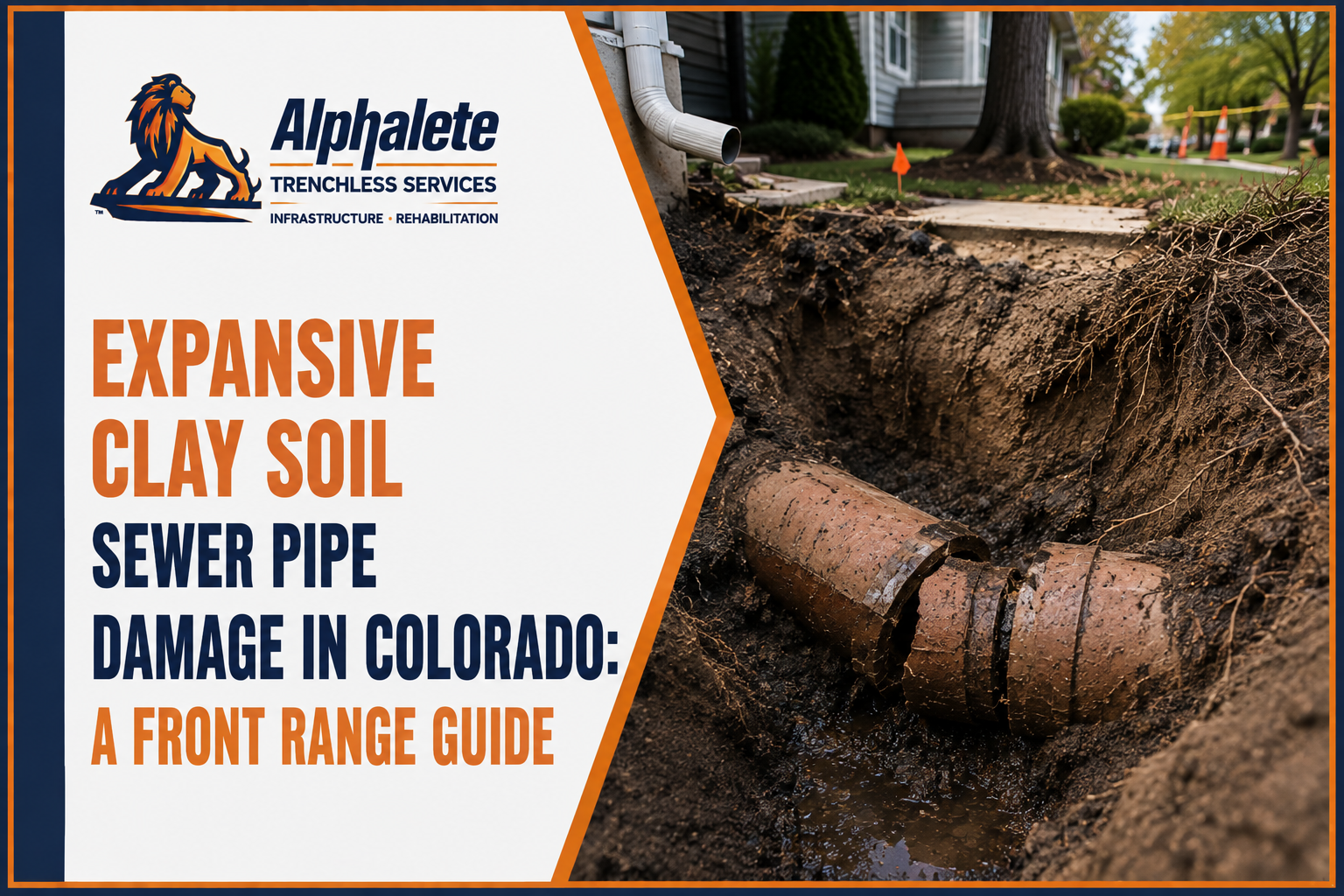
- Offset joints: pipe sections shift sideways or drop, so the connections no longer line up and no longer seal.
- Bellies (sags): a low spot forms where the pipe dips, collecting water, sludge, and waste that cause recurring clogs.
- Cracks and shears: the pipe wall fractures or a joint pulls apart under the swelling pressure.
- Root intrusion: once a joint opens, tree roots follow the moisture inside and accelerate the blockage.
This is why a Front Range homeowner can snake the same line year after year and never fix the problem. The clog is a symptom. The moving soil is the cause.
Why does soil damage show up after summer storms?
Because a storm is when the ground swells fastest and water is available to get into the pipe. Colorado’s monsoon runs from roughly July into September, with the most active stretch from mid-July through August, according to the National Weather Service. After a hot, dry early summer, the clay is shrunken and cracked. The first heavy storms swell it quickly and push water into any joint or crack the movement has opened, so a line that seemed fine in June can back up in July.
If your drains back up mainly during or after heavy rain, see why your sewer backs up when it rains for the other causes worth ruling out.
Is bentonite soil causing pipe shifting in Denver homes?
Yes, bentonite soil and pipe shifting in Denver go hand in hand, especially in older neighborhoods. Bentonite is among the most reactive of the expansive clays, and it is common across the Denver metro. Homes built decades ago often have sewer laterals made of vitrified clay tile or cast iron, both of which are rigid and jointed, so they have very little tolerance for the seasonal heave and settlement that bentonite-heavy ground produces.
You do not need a laboratory soil test to suspect it. Warning signs that shifting soil is stressing your sewer line include slow or gurgling drains throughout the house, sewage odors in the yard, patches of unusually green or soggy lawn over the pipe path, and clogs that keep returning after cleaning. A camera inspection is the reliable way to confirm what is actually happening underground.
Which sewer pipes are most at risk along the Front Range?
Older, rigid, jointed pipe is the most vulnerable to expansive clay soil sewer pipe damage in Colorado. The two biggest offenders are:
- Vitrified clay tile: common in mid-century and older homes, installed in short sections with many joints, and brittle enough to crack when the ground flexes.
- Cast iron: strong when new but prone to internal corrosion and scaling with age, which leaves it weak and easy to fracture or offset when the soil moves.
Newer PVC and ABS lines flex more and have fewer joints, so they tend to fare better, but no rigid pipe is immune when the soil around it is swelling with 20,000-plus pounds of force per square foot. If your home is on its original sewer lateral and predates modern plastic pipe, expansive soil should be near the top of your suspect list.
How does trenchless repair fix sewer pipes in expansive soil?
Trenchless repair rebuilds a failing sewer line from the inside or pulls a new one through the old path, without excavating the entire pipe. That makes trenchless repair well suited to expansive soil, because it restores a continuous, jointless pipe that stands up to ground movement far better than the old jointed line it replaces. Two methods do most of the work along the Front Range.
Cured-in-place pipe lining (CIPP)
Cured-in-place pipe lining, or CIPP, threads a resin-saturated liner through the existing pipe and cures it in place to form a new pipe inside the old one. The result is a smooth, seamless, jointless liner, and joints are exactly where expansive soil does its damage. With the weak points sealed into one continuous wall, offsets and root intrusion have nowhere to start. CIPP works well when the host pipe still holds its basic shape and alignment.
Pipe bursting
Pipe bursting pulls a new pipe through the path of the old one while a bursting head breaks the failed pipe outward into the surrounding soil. It typically needs only small access pits at each end rather than a full trench. Because the replacement is a continuous run of modern pipe, it is a strong choice when a line is collapsed or too far gone to line. A badly bellied section is different: because bursting follows the old path, a sag usually has to be dug up and re-laid at the correct slope. Both methods leave you with a modern pipe that tolerates seasonal soil movement much better than aging clay tile or cast iron.
You can compare lining, pipe bursting, and the cases where digging is still the better choice in our overview of trenchless pipe repair services.
Why is trenchless better than open-trench digging in shifting soil?
Trenchless is often the better fit for shifting soil because it disturbs far less ground than a full open-trench dig. Every time you excavate a long trench in expansive clay, you disturb the moisture balance of that soil, and disturbed clay can swell and settle unevenly as it re-absorbs water. Trenchless methods keep most of the surrounding soil intact and undisturbed.
The practical advantages for Front Range homeowners include:
- Landscaping, driveways, patios, and mature trees are largely preserved instead of torn up.
- Less soil is disturbed, so there is less re-settling to deal with afterward.
- The new jointless pipe is built to handle the same soil movement that broke the old one.
- Projects are often completed faster than a full dig-and-replace.
Open-trench replacement still has its place, particularly where a line has fully collapsed or the route is obstructed. The right call depends on the pipe’s condition, which is why a camera inspection comes first.
Frequently asked questions
Does expansive clay soil really damage sewer lines in Colorado?
Yes. The Colorado Geological Survey specifically lists disruption of pipelines and sewer lines as a common result of the state’s expansive soils. Along the Front Range, that swelling and shrinking clay is one of the leading reasons older sewer laterals develop offsets, bellies, and cracks.
How do I know if my sewer problem is caused by soil movement and not just a clog?
A repeat clog that comes back after cleaning is the classic sign that the pipe itself has shifted, not just filled with debris. Bellies, offset joints, and cracks show up clearly on a camera inspection, which tells you whether you are dealing with a blockage or structural soil damage.
Can trenchless repair work in Denver’s bentonite clay soil?
Yes. Trenchless repair is a good match for bentonite soil and pipe shifting in Denver because it replaces jointed, brittle pipe with a continuous, jointless line and disturbs far less of the surrounding clay than a full excavation. That combination holds up better through the seasonal wet-and-dry cycles that stress buried pipe.
Will new pipe eventually fail in expansive soil too?
No pipe is completely immune to ground movement, but modern, continuous, jointless pipe tolerates it far better than aging clay tile or cast iron. Removing the joints and corrosion points takes away the exact weaknesses that expansive clay exploits first.
Which trenchless method is right for my line, CIPP or pipe bursting?
It depends on the pipe’s condition. Cured-in-place lining suits pipes that still hold their shape and alignment, while pipe bursting suits lines that are collapsed or beyond lining. A badly bellied section usually needs a spot dig to reset its slope. A camera inspection is what determines the best approach for your specific line.
Are newer homes safe from expansive soil sewer damage?
Newer construction is often better engineered for swelling soils, and newer PVC lines tolerate movement better than clay tile or cast iron. But the pipe still sits in the same clay, and movement can affect any line over time, which is why camera inspections matter for older and newer homes alike.
Have a sewer line that keeps failing? Start with a camera inspection
If your Front Range home has drains that clog again and again, the soil under your yard may be the real culprit. Alphalete Trenchless serves the Denver metro and the Colorado Front Range, and a sewer camera inspection is the clear first step: it shows exactly what is happening inside the pipe so the right trenchless solution can be matched to your line. Contact Alphalete Trenchless to schedule a sewer camera inspection and get answers about your sewer line.