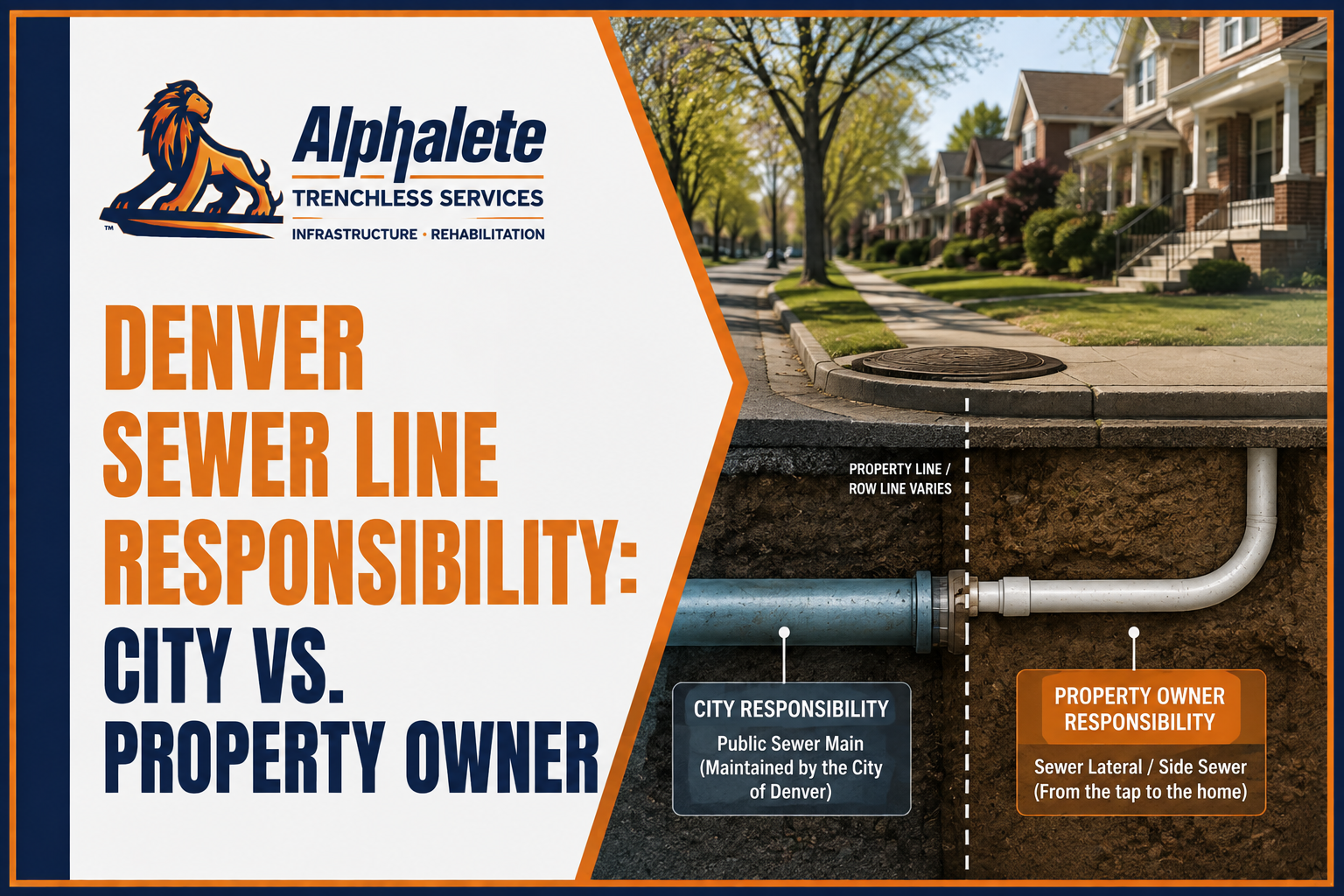
Quick answer: In most Denver-area jurisdictions, the property owner is responsible for the private sewer line (the lateral, sometimes called the side sewer) that runs from the home to the connection at the public main, while the city or sanitation district maintains the main line itself. So the question of who pays for sewer line repair Denver homeowners face usually comes down to which side of that connection point the problem sits on. Because exact boundaries vary by municipality and district, always confirm your specific responsibility line with your local utility before you assume anything.
Who is responsible for the sewer line between my house and the street?
Generally, the property owner is responsible for the sewer line between the house and the street, all the way to where it ties into the public main. This privately owned section is called the lateral or side sewer. A common misconception is that responsibility stops at the property line or the curb, but in many Denver-area jurisdictions the owner’s responsibility continues to the actual tap at the main, which can sit under the sidewalk, the parkway, or even the street.
That distinction matters because it means a homeowner can still be responsible for a broken pipe that is physically closer to the street than to the house. The only way to know your exact dividing point is to verify it with the municipality or sanitation district that serves your address.
Who is responsible for the sewer line under the street?
In the City and County of Denver, the part of your private sewer line that runs under the street is generally the property owner’s, not the city’s, all the way to the point where it connects to the public main. Denver’s municipal code makes sewers built in public ways city property, but it expressly excludes the portion of a private or building sewer that extends into the public right-of-way to the connection with the public sewer, and it places the cost of building private sewers on their owners (Denver Revised Municipal Code, Secs. 56-43 and 56-44). The public main itself is the city’s.
Because that segment sits under a public street, working on it is regulated too. Denver requires a permit from the Department of Transportation and Infrastructure before anyone opens or uncovers a sewer in a public way (Sec. 56-76), and private and building sewer work must be performed by a licensed plumber or certified drainlayer (Sec. 56-79).
Suburbs and independent sanitation districts set their own boundaries, so the answer can change one town over. If you are not sure whether a break is under your yard or under the street, a sewer camera inspection measures its distance and depth so you can compare it with the connection point before you call your utility.
What part of the sewer system does the city own?
The city (or the local sanitation district) owns and maintains the public main, which is the larger pipe that collects wastewater from every lateral in the neighborhood and carries it to treatment. When a problem originates in that public main, the utility is generally responsible for repairing it.
The gray area is the connection itself and any portion of the lateral that runs through public right-of-way. Responsibility for that segment is not uniform across the Front Range. Denver, Aurora, Lakewood, Littleton, Centennial, and the many independent water and sanitation districts can each define the boundary differently, so a rule that applies in one town may not apply one suburb over. Treat “generally the owner to the main” as a starting point, then verify locally.
Why does a sewer scope inspection matter for figuring out responsibility?
A sewer scope inspection matters because it shows exactly where a problem is located, which is the single most important fact in deciding whose responsibility it is. A camera pushed through the line pinpoints the depth and distance of a crack, blockage, root intrusion, or collapse, and that location can be measured against the known connection point to the main.
Without that evidence, responsibility is a guess. With it, you have a documented record you can take to your utility, your insurer, or a buyer or seller in a real estate transaction. In the Denver market, a sewer scope is a common part of a home inspection precisely because it establishes the condition and location of the lateral at a specific point in time.
What about “denver sewer scope inspection cost”?
The cost of a Denver sewer scope inspection depends on factors like line length, access points, and whether locating equipment is needed, so it is best to request a current quote rather than rely on a fixed figure. What the inspection buys you is clarity: it can prevent a much larger and more expensive surprise later by catching a failing lateral before a full backup, and it documents whether the fault sits on the owner’s side or the public side of the connection.
What factors affect the scope and cost of a sewer line repair?
The scope of a sewer line repair is driven mostly by where the damage is, how deep the line runs, and what the pipe is made of. Several factors influence how involved (and how costly) a repair becomes:
- Location of the fault: a break under a driveway, mature landscaping, sidewalk, or street is more complex to reach than one in an open yard.
- Depth and length of the lateral: deeper and longer runs take more work to access and rehabilitate.
- Pipe material and age: older Denver-area homes often have clay, cast iron, or Orangeburg pipe that is more prone to cracking and root intrusion.
- Cause of failure: root intrusion, offset joints, bellies, corrosion, and full collapses each call for different approaches.
- Access and permitting: work in the public right-of-way typically involves the municipality and added coordination.
These are the levers behind any estimate. This is also why two homes on the same block can receive very different repair plans.
How does trenchless repair apply to the private lateral?
Trenchless repair applies to the private lateral by rehabilitating or replacing the pipe with little to no open excavation, which is especially useful when the line runs under finished surfaces. One common method is cured-in-place pipe (CIPP) lining, where a resin-saturated liner is installed inside the existing pipe and cured to form a new pipe within the old one. Another is pipe bursting, which pulls a new pipe through the path of the old one.
Because the lateral is the property owner’s responsibility, it is usually the owner who benefits from a trenchless approach on that segment: less digging across yards, driveways, and landscaping, and often a faster restoration. Whether a specific line is a candidate depends on its condition, which comes back to the camera inspection.
How can a Denver homeowner confirm their exact responsibility?
The most reliable way to confirm your responsibility is to contact your local water and sanitation provider and ask where their maintenance responsibility ends and yours begins for your address. Rules genuinely vary by jurisdiction, and utility staff can tell you where the connection to the main sits and what portion, if any, they maintain.
Pair that call with a documented camera inspection of your line. Between the utility’s answer and a dated video record of your lateral, you will know both where the problem is and who is responsible for it before any money is spent.
Frequently asked questions
Does homeowners insurance cover sewer line repair in Denver?
It depends on your policy. A standard homeowners policy often excludes wear, tear, and gradual failure of a buried sewer lateral, though some insurers offer a separate service line endorsement that may help. Review your specific policy language and ask your agent, since coverage is not uniform.
If the broken pipe is under the street, is it automatically the city’s problem?
Not necessarily. In many Denver-area jurisdictions the owner’s responsibility for the lateral extends to the tap at the public main, which can be located under the sidewalk or street. Physical location alone does not decide responsibility, so verify the boundary with your local utility.
Do I need a sewer scope when buying an older Denver home?
A sewer scope is strongly recommended for older Denver-area homes. Many have clay, cast iron, or Orangeburg laterals that are prone to root intrusion and cracking, and a camera inspection documents the line’s condition before you close.
Who is responsible for the sewer lateral in an HOA or shared community?
Responsibility in an HOA or shared community depends on the governing documents and the district that serves it. Some laterals are individually owned, others fall under shared or association maintenance. Check your HOA declaration and confirm with your sanitation district. If the association or a property manager is responsible for a shared line, our page on commercial sewer lining for Denver HOAs and multi-unit buildings explains how those repairs are handled.
What should I do first if I have a sewer backup?
Stop using water to limit further backup, then arrange a camera inspection to locate and identify the cause. The inspection tells you where the fault sits relative to the public connection, which guides both the repair plan and the responsibility question.
Know your line before you need it
The responsibility boundary is not something to figure out during an active backup. If you are unsure who owns which part of your line, the practical first step is to schedule a sewer camera inspection to locate and document the condition of your lateral, then confirm the dividing point with your local utility. If the inspection reveals a problem on your side, our team can walk you through trenchless sewer line repair options, including cured-in-place pipe (CIPP) lining, for homes across the Denver metro.
Sewer responsibility rules vary by municipality and sanitation district. The guidance above is general. Always confirm the specific boundary for your address with your local water and sanitation provider.