Quick answer: Frost heave happens when water in the soil freezes, expands, and forms ice lenses that lift and shift anything buried in the ground, including your sewer pipe. In Colorado, repeated freeze-thaw cycles raise and drop the pipe over and over, and that constant movement cracks joints and pulls fittings apart. Frost heave sewer line damage in Colorado is most common in older clay and cast iron pipes buried close to the frost line, and trenchless CIPP lining can rebuild the pipe from the inside without digging up a frozen yard.
What is frost heave and why does it damage sewer lines?
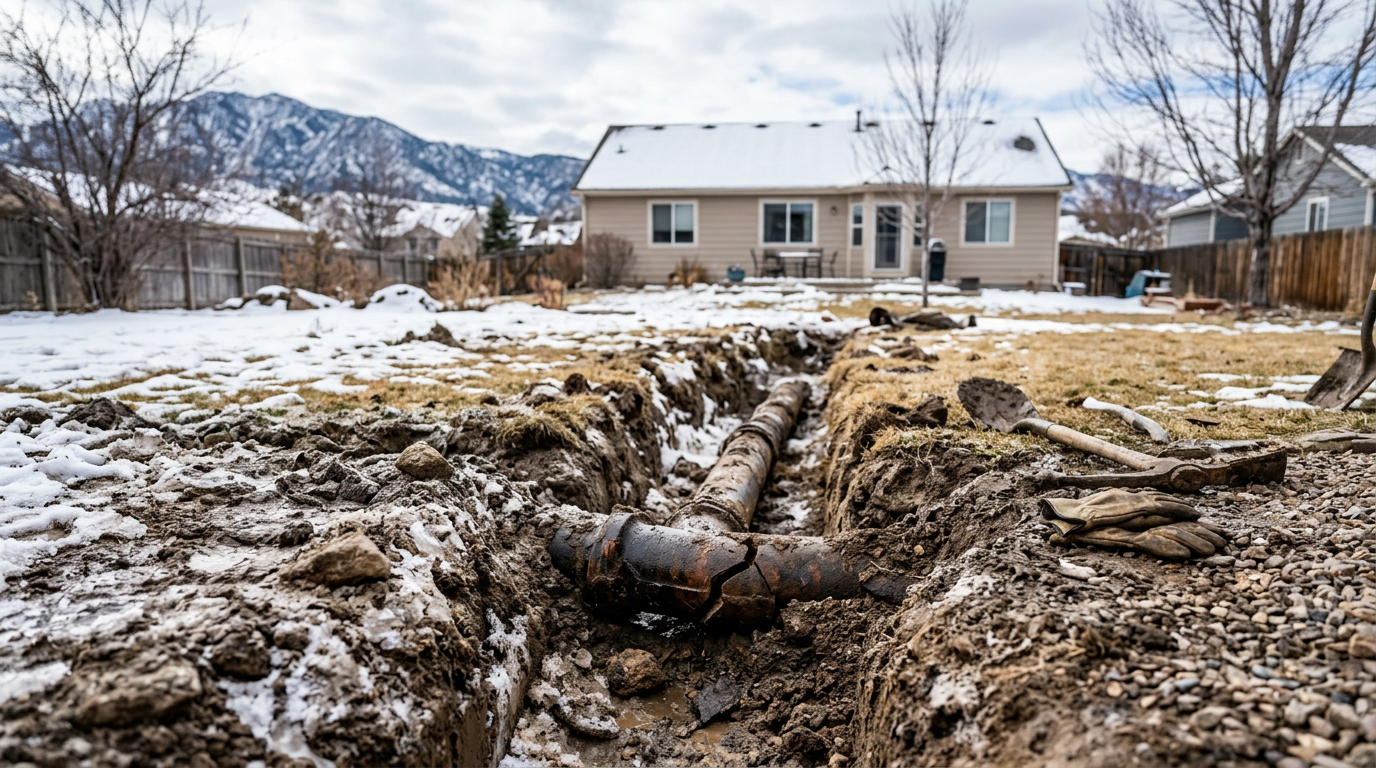
Frost heave is the upward movement of soil caused by freezing water expanding underground, and it damages sewer lines by lifting and shifting sections of pipe until the joints crack. It is not simply water turning to ice in the pipe. The bigger force is ice lens formation, where freezing temperatures pull nearby groundwater toward the frost front, and that water freezes into growing bands of ice that push soil (and pipe) upward.
The problem for a sewer line is that the ground never heaves evenly. One section of pipe lifts while another stays put, so the pipe is bent and twisted at its weakest points: the joints and fittings. Do that once and the pipe usually survives. Do it dozens of times across a single winter, and those joints fatigue, separate, and crack. Water and roots then find the openings, and a small gap becomes a full failure.
Why is frost heave sewer line damage worse at Colorado altitudes?
Colorado sewer lines take more frost-heave abuse than pipes in warmer states because the Front Range crosses above and below freezing far more often each winter. A sunny 50-degree afternoon followed by a below-zero night is a normal January day here, and each swing is another freeze-thaw cycle working on the soil around your pipe. Colorado Springs alone averages well over 50 freeze-thaw cycles a year, and the cold soil temperatures documented by CSU Extension show how deep that freezing reaches.
Higher towns feel it more. Woodland Park sits at about 8,500 feet, and its construction specifications call for sewer service lines to be buried at least three feet deep and insulated where they have less than six feet of cover. A shallow or uninsulated lateral there is worth a camera check before winter, and our page on sewer line repair in Woodland Park covers what that local work involves.
Three local factors make it worse. First, many older Colorado homes have sewer lines buried shallower than today’s code, which puts them right in the freeze zone. Second, the clay-heavy soils along the Front Range hold water, and water is the fuel that feeds ice lenses. Third, that same clay creates a separate problem: it swells and shrinks with moisture. That movement is not frost heave, it is expansive clay soil that swells and shrinks with moisture, and a single Colorado sewer line can be hit by both. Frost heave moves the pipe with temperature, expansive soil moves it with moisture, and the joints pay for both.
What are the warning signs of a frost-heaved sewer line?
The clearest warning signs of a frost-heaved sewer line are drainage problems that track with the cold: slow drains that worsen in winter, sagging pipe sections visible on a camera inspection, and backups that appear right after a thaw. Any one of these is worth investigating, and together they point strongly at seasonal ground movement.
Slow drains that get worse in cold months
Drains that run fine in July but crawl in January often signal a pipe that shifts when the ground freezes. As frost heave narrows or misaligns a joint, waste catches at that point, and the slowdown eases again once the ground thaws and the pipe partially settles back.
Bellied or sagging pipe sections
When frost heave repeatedly lifts and drops a run of pipe, it can leave a low spot that never drains fully. That dip is a bellied or sagging sewer line, and it shows up on camera as a pool of standing water and settled debris in an otherwise clear pipe.
Recurring backups right after a thaw
Backups that hit within a day or two of a warm-up are a classic frost-heave tell. As the soil relaxes, a cracked or offset joint opens further, roots and debris that packed in over winter break loose, and the line clogs. If you are clearing the same backup every spring, the pipe, not the fixture, is the problem.
Which pipe materials fail first under frost heave?
Older clay and cast iron pipes fail first because both are rigid and brittle, so they crack instead of flexing when the ground moves. Clay pipe is joined in short segments, and every joint is a hinge point that frost heave can pry open. Cast iron corrodes and thins from the inside over decades, which leaves it far weaker when the ground starts pushing on it.
Most at risk are Colorado homes built between roughly 1950 and 1980, when clay and cast iron were standard. If that is your house, it is worth understanding why older clay and cast iron pipe fails in Colorado before a winter of freeze-thaw finds the weak joint for you.
How does trenchless repair fix frost-heave damage?
Trenchless repair fixes frost-heave damage by rebuilding the pipe from the inside, so there is no need to excavate a frozen, snow-covered yard in the middle of a Colorado winter. The most common method is cured-in-place pipe (CIPP) lining, where a resin-saturated liner is pulled into the existing pipe and cured hard, creating a smooth, jointless pipe within the old one.
That jointless result matters here, because frost heave does most of its damage at the joints. Sealing them into one continuous liner removes the exact weak points the freeze-thaw cycle attacks. When a line is too collapsed or displaced to line, pipe bursting can pull a new pipe through the old path instead. Alphalete’s residential trenchless CIPP pipe lining is backed by a 20-year warranty, and most repairs finish in a day or two with minimal digging. To keep a lined or newer pipe healthy, it also helps to prepare your sewer line for a Colorado winter before the first hard freeze.
Frequently Asked Questions
Can frozen ground crack a sewer pipe?
Yes. Frozen ground can crack a sewer pipe, mostly through frost heave rather than the water inside the pipe freezing. As soil freezes and ice lenses grow, they lift and shift the pipe unevenly, and that bending force cracks brittle joints and fittings over repeated freeze-thaw cycles.
How deep are sewer lines buried in Colorado?
Most residential sewer lines in Colorado are buried roughly 3 to 5 feet deep, ideally below the local frost line, which runs about 30 to 36 inches across much of the Front Range. Older homes were sometimes laid shallower, around 18 to 24 inches, which puts those pipes squarely in the freeze zone and at higher risk of frost-heave damage.
Does frost heave affect newer PVC lines?
Newer PVC lines handle frost heave far better than clay or cast iron because PVC flexes instead of shattering, and modern installs use fewer, glued joints. PVC is not fully immune, though. If the pipe was bedded poorly or buried too shallow, aggressive freeze-thaw movement can still stress connections and knock a run out of slope over time.
Worried that a Colorado winter is working on your sewer line? A quick camera inspection is the only way to see frost-heave cracks, offset joints, and bellied sections before they turn into a backup. Contact Alphalete Trenchless for a free camera inspection and estimate, and get a clear, no-dig plan to protect your pipe through the next freeze.
Service Areas
Trenchless Sewer Repair Service Areas in Colorado
Alphalete restores damaged sewer lines without digging for homeowners across Colorado. See where we provide trenchless sewer repair near you.