Cracked vs. Collapsed Sewer Pipe: What’s the Difference?
When a sewer line fails, it usually fails in one of two ways: a crack or a collapse. These are very different problems that require different repairs – and they carry different urgency levels. Knowing the difference helps you make better decisions when something goes wrong.
What Is a Cracked Sewer Pipe?
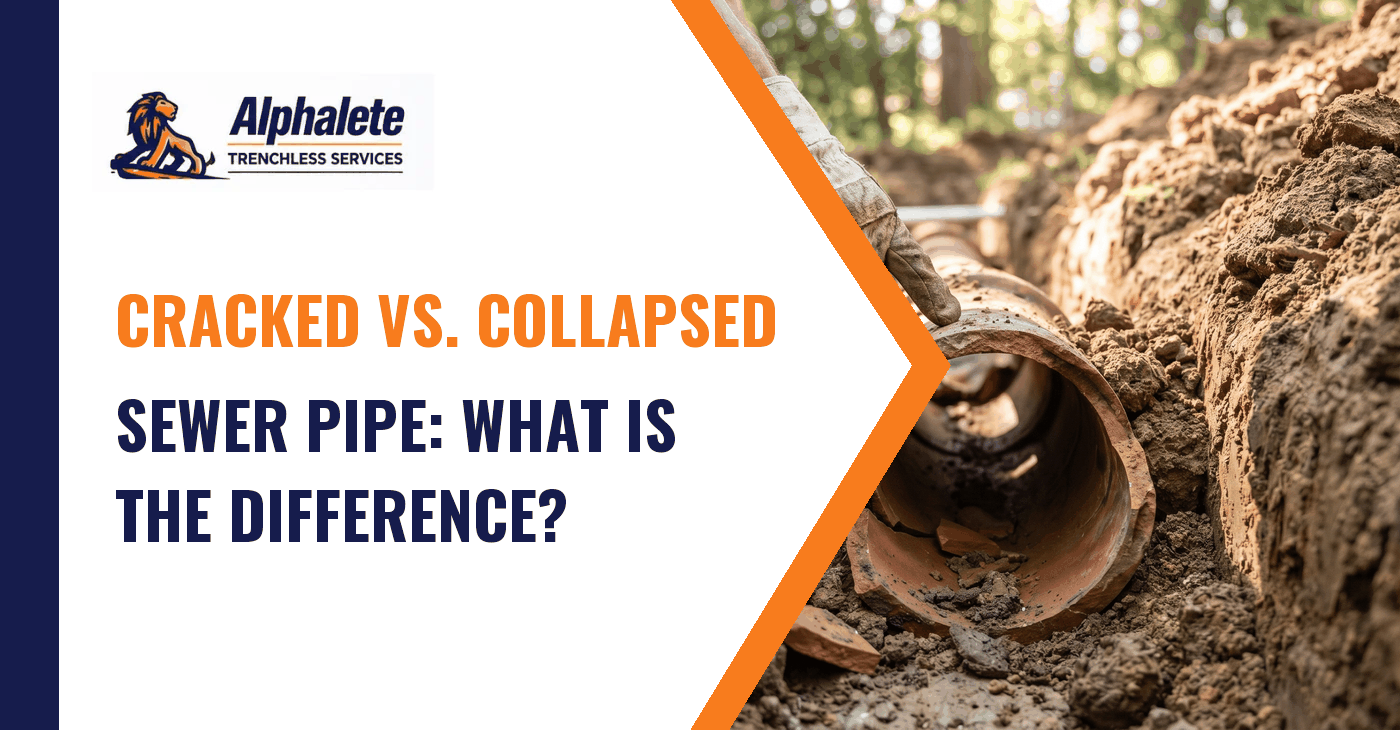
A crack is a fracture in the pipe wall. The pipe still has its basic shape, but the wall has been compromised. Cracks range from hairline fractures that allow minor seepage to larger breaks where sections of the pipe wall have shifted apart.
What Causes Sewer Pipe Cracks?
Several factors cause sewer pipes to crack, and many of them are common in Colorado Springs specifically:
- Tree root intrusion – Roots grow into small gaps at pipe joints, then expand inside the pipe until they crack it from within.
- Ground movement – The Front Range’s clay-heavy soil expands and contracts with moisture changes. This soil movement shifts and stresses pipes over time.
- Freeze/thaw cycles – Repeated freezing and thawing creates pressure on buried pipes, especially older clay or cast iron lines.
- Age and material degradation – Clay pipes installed before 1980 become brittle over time. Cast iron develops corrosion that weakens the pipe wall.
- Heavy loads above – Vehicles or heavy equipment over a buried line can compress the soil and crack the pipe beneath.
Signs of a Cracked Sewer Pipe
- Persistent slow drains that don’t fully resolve after snaking
- Recurring backups in the same drain or toilet
- Sewer odors from drains or in the yard
- Patches of unusually green or lush grass over the sewer run (sewage acting as fertilizer)
- Slightly higher water bills from groundwater infiltrating the line
What Is a Collapsed Sewer Pipe?
A collapse is a more severe failure. Instead of a crack in the wall, the pipe has caved in – partially or fully. The structural integrity of the pipe section is gone, and sewage cannot pass through normally.
What Causes Sewer Pipe Collapse?
- Advanced age in clay pipe – Older clay pipe that has been cracked and stressed for years eventually gives way entirely.
- Severe root intrusion – Root mass that has fully penetrated and expanded inside a pipe can cause the walls to fracture and cave.
- Soil erosion or washout – When soil washes away beneath a pipe, the unsupported section can collapse under its own weight.
- Improper installation – Pipes installed without proper bedding or support are more prone to collapse over time.
Signs of a Collapsed Sewer Pipe
- Multiple drains backing up simultaneously – a sign of total main line blockage
- Sewage backup in the lowest drain in the house (floor drain, basement toilet)
- Sunken or soft areas in the yard above the sewer line
- A sewer camera that reaches an obstruction it cannot pass through
Cracked vs. Collapsed: Why It Matters for Repair
Cracked Pipe Repair Options
A cracked pipe that still has its basic shape can often be repaired from the inside without digging. Trenchless pipe lining (CIPP) inserts a resin-saturated liner into the existing pipe and cures it in place – sealing cracks, spanning root entry points, and restoring structural integrity without excavation.
Before any lining work, the line is cleaned with hydro jetting and inspected with a camera. The camera footage confirms whether lining is appropriate for the specific damage found.
Collapsed Pipe Repair Options
A fully collapsed section is more involved. Options include:
- Pipe bursting – A trenchless method that fractures the old collapsed pipe outward while pulling a new pipe through. Works when the pipe run is still accessible at both ends.
- Spot excavation – Digging down to the collapsed section, removing it, and replacing that section. Appropriate when the collapse is localized and shallow.
- Full line replacement – When collapse is extensive or the pipe condition is poor throughout, full replacement may be the most cost-effective long-term solution.
Why a Camera Inspection Is the First Step
You can’t tell a crack from a collapse without looking inside the pipe. The symptoms overlap, and the right repair depends entirely on what the camera shows. A sewer camera inspection is the starting point for any sewer line diagnosis.
The EPA notes that sanitary sewer overflows are often caused by pipe failures that go undetected – exactly the kind of problem a camera inspection catches before it becomes an emergency.
Frequently Asked Questions
Can a cracked sewer pipe become a collapsed one if left alone?
Yes. Cracks worsen over time – roots grow in, soil infiltrates, and the pipe wall weakens further. A small crack caught early is much less expensive to repair than the collapse it can become.
How do I know if my pipe is cracked or collapsed without a camera?
You can’t know for certain without a camera inspection. The symptoms can be similar. If multiple drains are backing up simultaneously or you have sewage coming up from a floor drain, collapse is more likely – but camera inspection confirms it.
Is trenchless repair possible for a collapsed pipe?
It depends on the degree of collapse. Pipe bursting is a trenchless option for collapsed lines. If the collapse is severe, excavation may be necessary. A camera inspection determines which approach is viable.
How long does a cracked pipe repair take?
Most trenchless lining repairs for residential sewer cracks are completed in one day. A sewer camera inspection is scheduled first to confirm the scope.
Worried about your sewer line? Schedule a camera inspection with Alphalete Trenchless Pipelining and know exactly what you’re dealing with. Call (719) 650-2273.