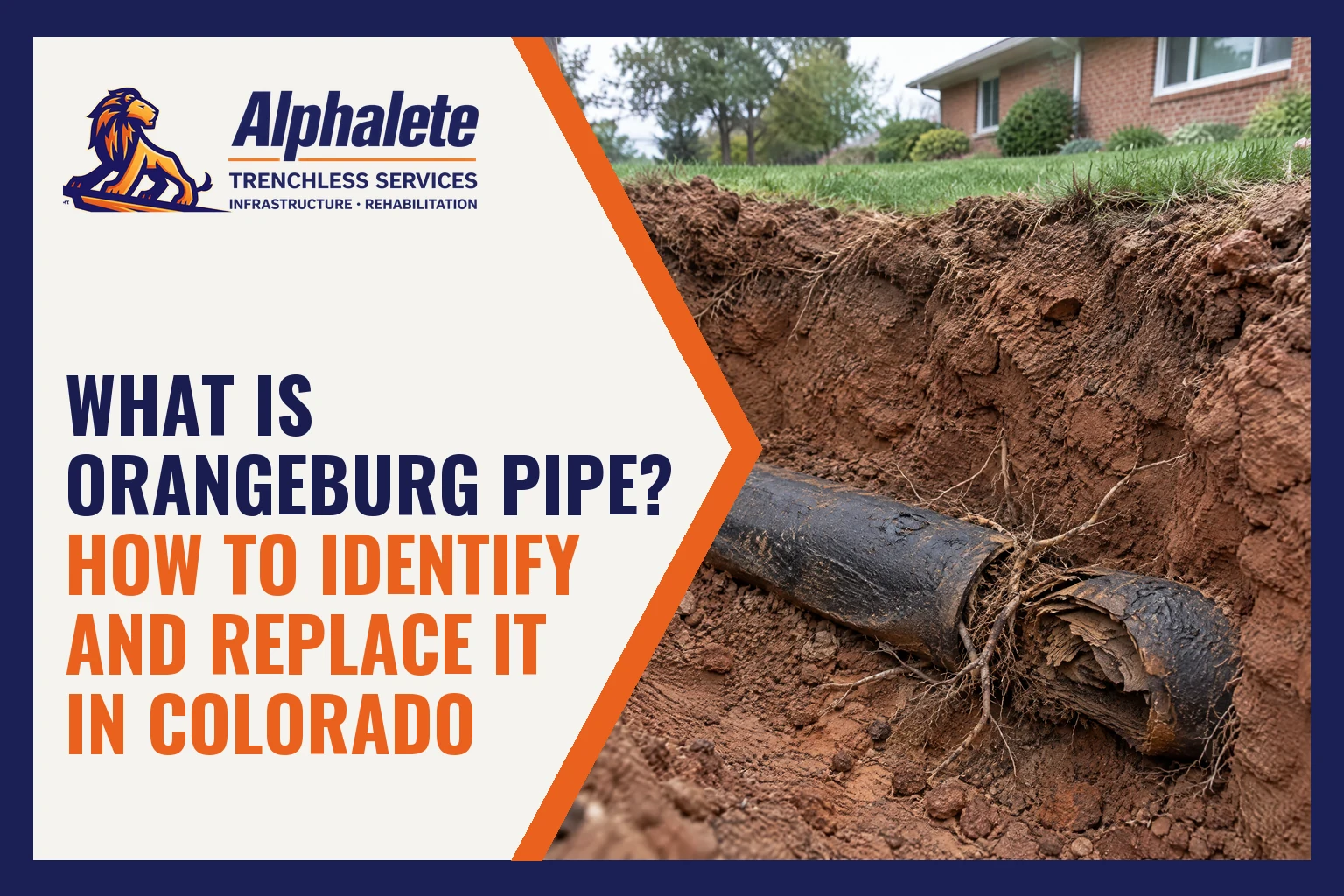
Quick answer: Orangeburg pipe is an old type of sewer and drain pipe made from layers of wood fiber soaked in coal tar pitch, used in many American homes built from the 1940s into the 1970s. Because it softens, flattens, and lets roots in as it ages, most Orangeburg pipe still in the ground is past its expected life. If your Colorado home was built in that era, a sewer camera inspection is the only reliable way to confirm what your line is made of and whether it can be lined or needs to be replaced.
What is Orangeburg pipe?
Orangeburg pipe is a bituminized fiber pipe made from compressed layers of ground wood pulp that were bound together and impregnated with liquefied coal tar pitch. Plumbers sometimes call it “fiber pipe” or “paper pipe” because the base material is essentially pressed wood fiber. It gets its name from Orangeburg, New York, where the Fiber Conduit Company (later the Orangeburg Manufacturing Company) produced most of it.
The pipe was light, cheap, and easy to cut, which made it attractive for sewer service lines, storm drains, and septic systems. Once moisture gets into the walls, the pipe loses strength.
When was Orangeburg pipe used, and which Colorado homes have it?
Orangeburg pipe was most widely used from the 1940s through the 1970s, with demand rising during World War II metal shortages and the housing boom that followed. According to a history published by the American Public Works Association Minnesota Chapter, the rise of PVC pipe in the 1970s ended its use, and the Orangeburg Manufacturing Company closed in 1974.
In Colorado, that means homes built roughly from the late 1940s through the early 1970s are the ones most worth checking. Many Front Range neighborhoods were built during those decades, including parts of Denver-area suburbs like Littleton and older neighborhoods in Colorado Springs. Not every home from that period has an Orangeburg sewer line, and some original lines have already been replaced. The build year tells you to look closer. It does not tell you what is actually underground.
Why does Orangeburg pipe collapse?
Orangeburg pipe collapses because its wood fiber walls absorb moisture over time, which makes the pipe soft enough to deform under soil weight and weak enough for roots to break through. Unlike clay or cast iron, it tends to bend and flatten before it cracks. The most common failure patterns include:
- Deformation (ovaling): Soil pressure slowly squeezes the round pipe into an oval or flattened shape, which narrows the flow path and causes repeat clogs.
- Blistering: The inner wall can bubble and swell into the pipe, creating rough spots where paper and waste catch.
- Delamination: The pressed layers separate and flake away, thinning the wall from the inside.
- Root intrusion: As the pitch dries out and the walls weaken, tree roots find openings and grow inside. See our guide to tree roots in a sewer line for how roots cause backups.
- Joint separation and sags: Connections can pull apart or shift, and sections of the line can sink into low spots (often called bellies) where water and solids collect.
Pinellas County, Florida, for example, notes that Orangeburg laterals are prone to bellying, root intrusion, and groundwater infiltration, and deteriorate faster than other pipe types. The City of Ann Arbor, Michigan also notes that the material flattens under the pressure of the surrounding soil as it deteriorates, and that tree roots usually invade at the joints. Left alone, a badly deformed section can eventually collapse. Our article on cracked vs collapsed sewer pipe explains why that difference matters for repair.
How to identify Orangeburg pipe
The only reliable way to identify Orangeburg pipe is a sewer camera inspection, because most of the line is buried and cannot be seen. Still, a few clues can tell you whether an inspection is worth scheduling soon:
- Check the age of the home. A house built from the 1940s through the early 1970s is a candidate, especially if the original sewer line has never been replaced.
- Look at any visible pipe. If you can see pipe near a cleanout or where the line leaves the foundation, Orangeburg is usually black or very dark, dull, and fibrous looking. Keep in mind that the pipe you can see may be a newer material even when the buried section is not.
- Notice the symptoms. Recurring slow drains, repeat backups in the lowest drain, gurgling, or sewer odors can point to a narrowed or root-filled line, although other pipe types cause these problems too.
A sewer camera inspection runs a waterproof camera through the line so you can see the material, the shape of the pipe, root intrusion, sags, and the exact location of any damage. On camera, Orangeburg often shows up as an oval or flattened opening with rough, blistered, or peeling walls where a round, smooth pipe should be.
How long does Orangeburg pipe last?
Orangeburg pipe was advertised to last about 50 years, and in real-world conditions many lines failed sooner. Since production ended in the mid-1970s, any Orangeburg still in service today is roughly 50 years old or older, which puts it at or beyond that original estimate.
Orangeburg pipe life expectancy varies a lot from one property to the next. Soil type, moisture, depth, nearby trees, and how well the line was installed all play a role. Age alone does not tell you the condition, so it is best to see the inside of the pipe before deciding anything.
Can Orangeburg pipe be lined, or does it need replacement?
Orangeburg pipe can sometimes be lined, but only when the pipe still holds its round shape after it has been cleaned; deformed, heavily delaminated, or collapsed sections usually need pipe bursting or a spot excavation instead. Cured-in-place pipe (CIPP) lining installs a new resin liner inside the old pipe, so the existing pipe has to be open and stable enough for the liner to cure against it.
- Pipe is still mostly round and intact: After careful cleaning (often hydro jetting at controlled pressure, because softened Orangeburg walls can be damaged by aggressive cleaning), a CIPP liner may be an option.
- Pipe is ovaled, flattened, or has sections that have collapsed: A liner cannot restore a pipe that has lost its shape. Pipe bursting, which pulls a new pipe through the path of the old one while breaking the old pipe outward, is often the better trenchless choice.
- A short section has collapsed but the rest is sound: A small excavation at that point, combined with a trenchless method for the rest of the line, can make sense.
Some utilities have their own rules. Pinellas County’s private lateral program, for example, states that Orangeburg laterals must be replaced. Rules differ by city and utility, so confirm local requirements before work starts.
At Alphalete Trenchless Services, we run a camera inspection before recommending any Orangeburg pipe repair, so the recommendation is based on what the pipe actually looks like. You can compare both methods in our guide to CIPP lining vs pipe bursting, or learn more about trenchless sewer pipe lining for homes.
What affects the cost of Orangeburg pipe replacement?
Orangeburg pipe replacement cost depends mainly on how much pipe needs work, what condition it is in, and which repair method the camera inspection shows is possible. Because every property is different, an accurate price only comes after the line has been inspected. The main factors are:
- Length of the line: Longer runs from the house to the city main take more material and time.
- Depth of the pipe: Deeper lines are harder to reach for bursting pits or any excavation.
- Access points: Whether there are usable cleanouts, and what sits above the line (driveways, trees, patios, landscaping).
- Condition of the pipe: A round, intact pipe may be lined, while flattened or collapsed sections change the scope.
- Repair method: Lining, pipe bursting, spot repair, or a combination each involve different equipment and labor.
- Permits and inspections: Local permit and inspection requirements vary by city and utility.
- Restoration: Any concrete, asphalt, or lawn that has to be disturbed and restored adds to the project.
Should you buy a home with Orangeburg sewer pipe?
You can buy a home with Orangeburg sewer pipe, but you should get a sewer scope before closing so you know the pipe’s condition and can factor any repair into your decision and negotiations. A standard home inspection usually does not include the buried sewer line, so a problem can go unnoticed until after you move in.
If the scope confirms Orangeburg, ask for the video and a written description of the findings. That record helps you compare repair options, talk with the seller about credits or repairs, and plan ahead. Our guide to getting a sewer scope before buying a home covers what to expect. If you are shopping in the Pikes Peak region, we also handle trenchless sewer repair in Colorado Springs.
Frequently asked questions
What is Orangeburg sewer pipe made of?
Orangeburg sewer pipe is made of compressed layers of ground wood fiber bound together and impregnated with coal tar pitch, and some batches also contained asbestos fibers. It was used in many homes built from the 1940s into the 1970s and tends to soften and deform as it absorbs moisture.
How do I know if my house has Orangeburg pipe?
A sewer camera inspection is the only reliable way to know if a house has Orangeburg pipe. A build year from the 1940s through the early 1970s, dark fibrous pipe visible near a cleanout, and repeat clogs or backups are clues that an inspection is worth scheduling.
Can Orangeburg pipe be lined?
Orangeburg pipe can be lined only if it still holds its round shape and is structurally stable after cleaning. If the pipe is flattened, badly delaminated, or collapsed, pipe bursting or a spot excavation is usually needed instead, and a camera inspection determines which applies.
Does Orangeburg pipe have to be replaced right away?
Orangeburg pipe does not always need immediate replacement, but it should be inspected, because its condition can range from still flowing to partly collapsed. A camera inspection shows how urgent the repair is and which method fits the pipe.
Does homeowners insurance cover Orangeburg pipe?
Usually not for the pipe itself. Standard homeowners policies typically do not pay to replace a sewer line that fails from age, deterioration, or root intrusion, which is how most Orangeburg lines fail. Some insurers offer a service line endorsement that may help, so check your policy. Our guide to homeowners insurance and sewer line repair in Colorado explains what policies typically cover.
Does Orangeburg pipe contain asbestos?
Some Orangeburg pipe does. The City of Ann Arbor, Michigan describes it as a mix of plant-based fibers and asbestos soaked in a tar-like substance, although not every batch was made the same way. Pipe that stays buried and undisturbed is generally considered low risk, but cutting, breaking, or grinding it during removal can release fibers, so old Orangeburg should only be removed by contractors who follow asbestos safety rules.
If your home was built in the post-war decades or you are about to buy one, the next step is simple: book a camera inspection with Alphalete Trenchless Services so you can see what is in your sewer line before deciding on a repair.