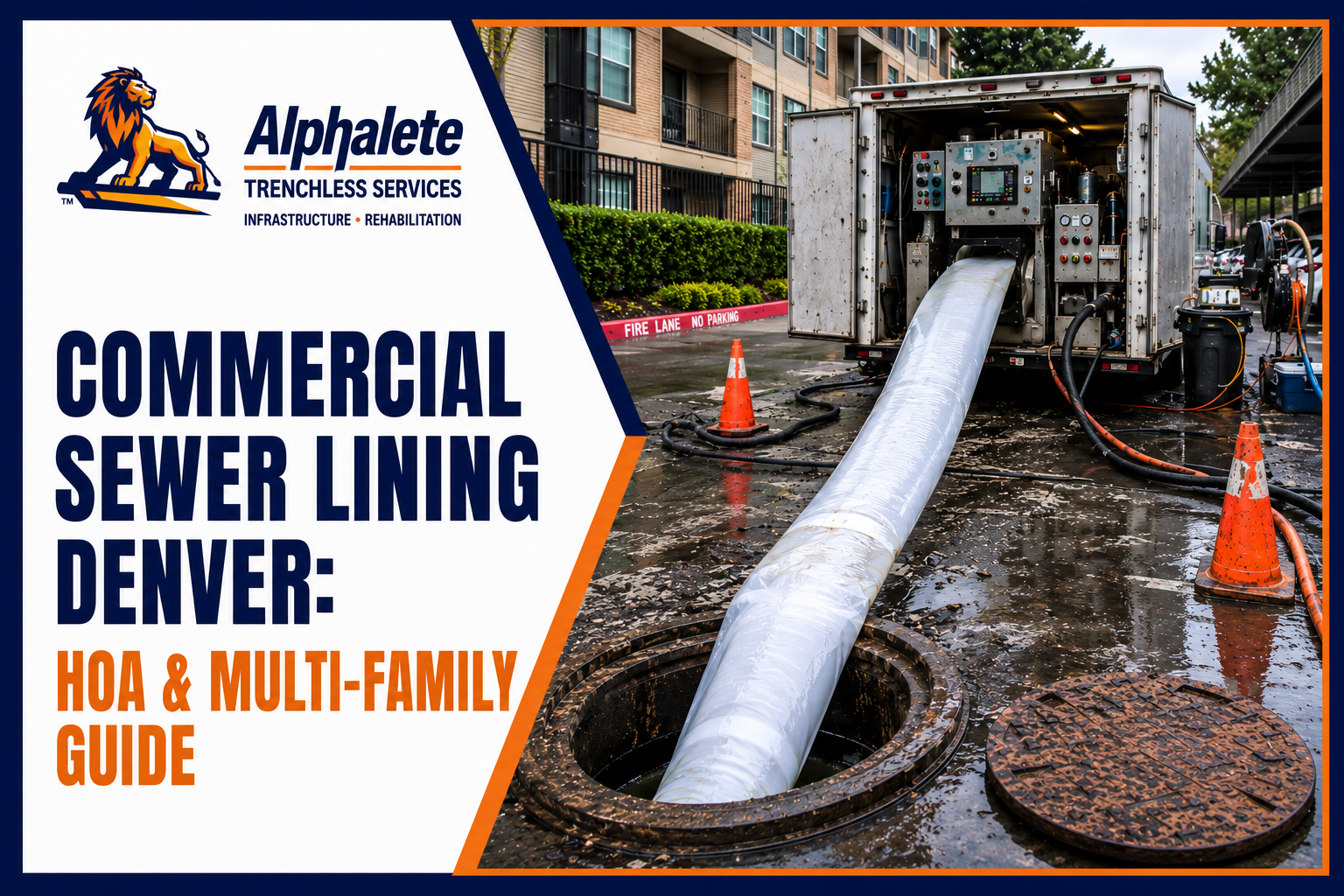
Quick answer: HOA sewer line repair in Denver, like other commercial sewer lining projects, rehabilitates failing sewer mains and laterals under businesses, HOAs, and multi-family communities without open excavation. A cured-in-place liner (CIPP) or a pipe-bursting replacement is installed through existing access points, so tenants keep using water, parking lots stay paved, and daily operations continue while the pipe is restored from the inside.
If you manage a commercial building, sit on an HOA board, or run facilities for an apartment community, a sewer failure is not just a plumbing problem. It threatens tenant satisfaction, parking, landscaping, and your operating budget. Trenchless rehabilitation exists to solve those pipes without tearing your property apart. Here is how it works for shared and large-scale systems along the Front Range.
Why do commercial and HOA sewer lines in Denver fail?
Commercial and HOA sewer lines fail because they carry heavier, more constant use through pipe that is often decades old, and Denver-area ground conditions accelerate the damage. Shared systems rarely rest the way a single home’s line does, so wear compounds faster.
The most common failure drivers we see in Metro Denver include:
- Heavy, continuous flow. Apartments, retail centers, restaurants, and office buildings push far more water and waste through a line than a single household, so grease, scale, and solids build up faster.
- Aging mains and original materials. Many established Denver neighborhoods and older HOA communities still run on clay tile or cast iron that has cracked, corroded, or shifted at the joints.
- Root intrusion. Mature trees in established HOA and apartment landscaping send roots into pipe joints, where they expand and block flow.
- Ground movement. Colorado’s expansive clay soils swell and shrink with moisture, and freeze-thaw cycles add stress, which pulls pipe joints apart and creates bellies and offsets.
- Shared laterals. When multiple units or buildings tie into one lateral, a single failure can back up several tenants at once, which raises the urgency and the coordination challenge.
What is the business case for trenchless sewer rehabilitation?
The business case for trenchless rehabilitation is simple: it restores the pipe while keeping your property open and your residents in place. Traditional open-cut excavation means digging trenches through parking lots, drive lanes, courtyards, and landscaping, which shuts down access and generates restoration costs long after the pipe is fixed.
For a decision-maker, the practical advantages line up against the things you are actually accountable for:
- Minimal disruption to tenants and operations. Most trenchless work is completed through existing cleanouts or small access points, so businesses can keep serving customers and residents can keep using their units.
- Parking and landscaping stay intact. There is no long trench to excavate and repave, which protects the surfaces and amenities your budget would otherwise have to restore.
- Faster return to normal. Rehabilitating a line from the inside typically takes less on-site time than digging, replacing, and rebuilding the surface above it.
- Cleaner coordination. Fewer crews, less heavy equipment, and a smaller footprint make the project easier to schedule around occupied buildings.
Rehabilitating shared infrastructure also fits how public agencies address aging systems, since cured-in-place pipe has become a widely used, trenchless standard for renewing sewer mains without digging them up.
HOA sewer line repair: how CIPP and pipe bursting work at scale
Commercial sewer lining Denver work generally uses one of two trenchless methods, matched to the condition of the existing pipe. Both are installed without a full excavation, and both are covered in more depth on our commercial trenchless pipelining in Denver page.
CIPP lining (cured-in-place pipe)
CIPP lining rebuilds a pipe from the inside by installing a resin-saturated liner into the existing sewer and curing it into a new, seamless pipe wall. It seals cracks, corroded joints, and root intrusion points, and it works well when the host pipe is damaged but still structurally present. Because the liner goes in through existing access, floors and parking surfaces stay in place.
Pipe bursting
Pipe bursting replaces a line that is too far gone to line by pulling a new pipe through the path of the old one while the old pipe is broken outward. It is the right call for pipes that have collapsed, badly offset, or lost too much wall to hold a liner. Access is limited to entry and exit points rather than a continuous trench.
On larger systems, a single project may combine both methods across different runs, lining the sections that can be lined and bursting the sections that cannot. That is why assessment comes first.
How does sewer camera inspection guide the plan?
Sewer camera inspection is the assessment step that turns guesswork into a documented plan. A camera is run through the line to record the exact location, type, and severity of each defect, which tells the crew where to line, where to burst, and where cleaning alone will do.
For a commercial or HOA project, that footage does double duty. It scopes the work accurately so phasing and access can be planned around occupied units, and it gives the board or property owner a clear record of the pipe’s condition before and after. You can see how this fits into a project on our sewer camera inspection page.
How do you rehabilitate sewer lines in an occupied building?
You rehabilitate sewer lines in an occupied building by planning access, phasing, and resident communication before any work begins, so tenants experience the smallest possible interruption. Occupied-property rehab is as much a coordination job as a construction job, and the details are where a project succeeds or stalls.
- Access mapping. The team identifies cleanouts, mechanical rooms, and exterior access points so most of the work happens outside living and working spaces.
- Phasing. On multi-building HOAs and apartment communities, the work can be sequenced building by building or riser by riser to limit how many units are affected at once.
- Resident and tenant notification. Clear advance notice about short water-use pauses lets residents plan around the work and cuts down on complaints and emergency calls.
- Downtime windows. Water service to affected units is typically paused only for the working window on that section, not the whole project, and scheduling can target lower-use hours.
- Documentation for the board. Before-and-after camera footage, a description of the methods used, and the location of the rehabilitated runs give an HOA board or owner a defensible record for reserves, budgeting, and disclosure.
Alphalete provides trenchless sewer service across Metro Denver, including commercial buildings, HOA communities, and multi-family properties.
Frequently asked questions
How long does trenchless sewer rehabilitation take for a commercial property or HOA?
Most commercial and HOA trenchless projects are completed in a shorter on-site window than open-cut excavation because there is no trench to dig, backfill, and repave. The exact timeline depends on the length and condition of the line, how many sections need lining versus bursting, and how the work is phased around occupied units, all of which are set during the camera inspection.
Will residents or tenants need to stop using water during the work?
Residents typically pause water use only for the working window on the specific section being rehabilitated, not for the entire project. With advance notification and phasing, most tenants and businesses continue normal operations for the majority of the job.
Can trenchless methods handle large or shared commercial laterals?
Yes. CIPP lining and pipe bursting are used on commercial mains and shared laterals, not just small residential lines. The camera inspection confirms the pipe’s diameter and condition so the right method is matched to each run before work begins.
What documentation will the HOA board receive?
An HOA board should receive before-and-after camera footage, a description of the trenchless methods used, and the locations of the rehabilitated sections. This record supports reserve planning, budgeting, and disclosure, and it gives the board a clear account of the property’s sewer condition.
Does Alphalete serve multi-family and commercial properties across Metro Denver?
Yes. Alphalete provides commercial, HOA, and multi-family trenchless sewer rehabilitation throughout Metro Denver, and our commercial sewer rehabilitation across Colorado covers properties throughout the Front Range. Methods and phasing are tailored to occupied buildings.
Schedule a commercial sewer assessment
The right rehabilitation plan starts with knowing exactly what is in the ground. To scope your property’s sewer system and build a phasing plan that protects your tenants, parking, and operations, schedule a commercial sewer assessment with the Alphalete team.