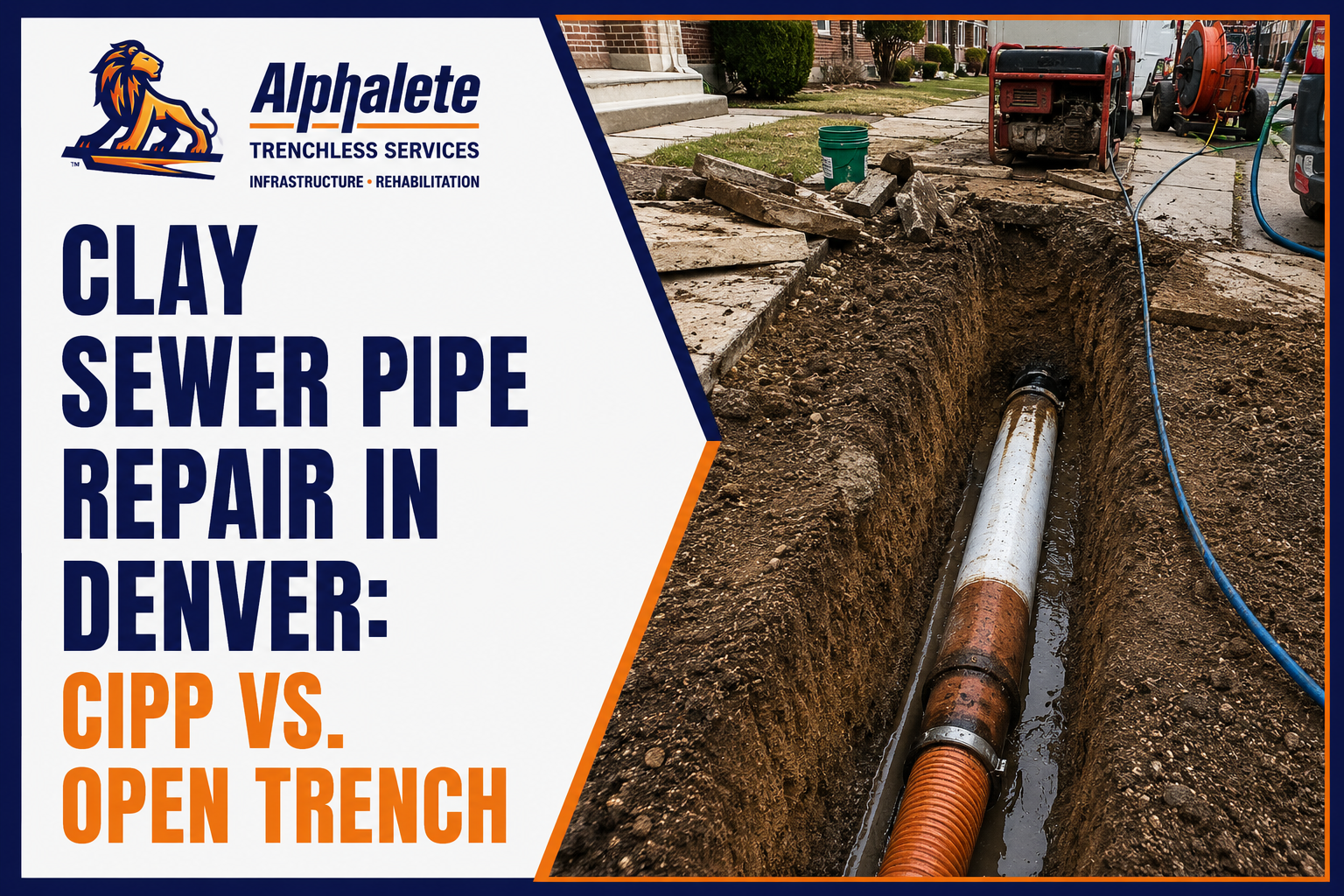
Quick answer: For most clay sewer pipe repair in Denver, cured-in-place pipe (CIPP) lining is the less disruptive fix. It rebuilds the pipe from the inside through one or two small access points, so mature trees, driveways, and vintage hardscape usually stay intact. Open-trench replacement is still the right call when the clay line is fully collapsed, badly offset, or crushed to the point that there is no sound host pipe left to line.
Why do historic Denver homes so often have failing clay sewer pipe?
Older Denver homes commonly have failing clay sewer pipe because vitrified clay was the standard residential sewer material for much of the early and mid twentieth century, and those systems are now well past their prime. Clay lines were installed in short sections joined with mortar or gaskets, and over decades those joints separate, crack, and let groundwater and tree roots find their way in.
Three things tend to go wrong in established neighborhoods:
- Age and material fatigue. Clay is brittle. Decades of soil movement and freeze-thaw cycles along the Front Range leave hairline cracks and broken sections. More on why old clay sewer pipe fails.
- Root intrusion. The mature trees that make historic Denver blocks so appealing send roots toward the moisture escaping at joint gaps. Once inside, roots expand, snag debris, and cause repeat backups. See tree roots in a sewer line.
- Joint offsets and bellies. As backfill settles, pipe sections shift out of alignment or sag, which slows flow and traps solids.
Denver-area soil adds to the strain: expansive clay soil swells and shrinks with moisture and shifts buried pipe. The private sewer line from the house to the city main is generally the property owner’s to repair, as our guide to who pays for sewer line repair in Denver explains.
Cracked and separated joints in aging clay laterals are one of the most common ways groundwater and roots get into a sewer line, which is exactly the pattern homeowners see in older Denver housing stock.
What is CIPP clay pipe lining, and how does it work?
CIPP clay pipe lining is a trenchless method that builds a new pipe inside the old clay one without digging up the yard. A resin-saturated liner is pulled or inverted into the existing sewer, inflated against the pipe wall, and cured in place until it hardens into a seamless, jointless pipe within a pipe.
Because the finished liner has no joints, it does two important things for a historic Denver home: it seals the gaps where roots used to enter, and it bridges the cracks and minor offsets that were slowing flow. Most Denver CIPP clay pipe lining projects need only a small access point or an existing cleanout, so the crew never has to trench across the length of the yard. For the full picture, see our page on trenchless sewer repair in Denver.
CIPP vs. open trench: which is better for clay sewer pipe repair in Denver?
For clay sewer pipe repair in Denver, CIPP lining is usually the better fit when the existing pipe still holds its shape, while open-trench replacement wins when the pipe is structurally gone. The right answer depends on the condition of the line, not a blanket rule, which is why a camera inspection comes first. Here is how the two methods compare on the factors historic-home owners care about most. For the general comparison beyond clay pipe, see trenchless vs. traditional sewer repair.
Disruption to landscaping, driveways, and historic hardscape
This is where trenchless usually pulls ahead for older Denver properties. Open-trench replacement means excavating a continuous trench along the sewer path, which can mean removing mature trees, tearing up a driveway, or disturbing original brick walkways, stone borders, and established garden beds that are hard or impossible to replace. CIPP works through compact access points, so the surface footprint is far smaller and the character of the property is preserved.
Timeline and daily disruption
Trenchless lining is typically completed in a much shorter window than a full dig-and-replace, and it avoids the extended backfill, compaction, and surface-restoration phase that open trenching requires. For a household on an older street, that often means less time with the sewer out of service and less mess in the yard.
Structural result and root resistance
Both methods produce a sound sewer line when done correctly. A cured liner creates a smooth, jointless interior that resists the root intrusion and joint leakage that caused the clay pipe to fail in the first place. A full replacement gives you a brand-new pipe as well, but at the cost of the excavation. When the host pipe is intact enough to line, most homeowners get the durability they want without the disruption.
When is open-trench replacement still necessary?
Open-trench replacement is still necessary when there is no usable host pipe left to line. Trenchless lining needs a pipe that holds its basic shape so the liner has something to cure against, and some clay lines are too far gone for that. Our guide to cracked vs. collapsed sewer pipe explains the difference.
Dig-and-replace is generally the honest answer when the camera shows:
- A fully collapsed section where the pipe wall has caved in.
- A severe offset or separation where sections have shifted so far apart that the line is effectively broken.
- Major sagging or a deep belly that needs to be re-graded, not just relined.
- A pipe so crushed or deteriorated that lining cannot restore proper flow.
An honest trenchless sewer repair for historic homes in Denver starts by ruling these out, not by assuming lining fits every situation. Sometimes a hybrid approach works best: spot-dig one failed section and line the rest.
How do you know which method your home needs?
The only reliable way to know is a sewer camera inspection, because the decision hinges on the actual internal condition of the clay line. A camera run shows where the cracks, root masses, offsets, and collapses are, so the method is matched to the pipe instead of guessed at. It also gives you documentation of the problem before any work begins, which is useful for older homes where you want to protect the surrounding landscape and hardscape.
Frequently asked questions about clay sewer pipe repair in Denver
Can a cracked clay sewer pipe be lined instead of dug up?
Often, yes, if it still holds its shape. Cracked clay lines that are still round are strong candidates for CIPP lining, but a fully collapsed, severely offset, or crushed pipe usually has to be replaced by excavation because there is no sound host pipe for the liner to cure against. A camera inspection determines which category your line falls into.
Will trenchless lining stop tree roots from coming back?
A properly installed cured-in-place liner creates a seamless, jointless interior with no gaps at the old joints, which are the openings roots used to exploit. That removes the entry points that let roots into the clay pipe, which is a major reason trenchless is popular on tree-lined historic Denver streets.
Is CIPP a good fit for historic Denver homes specifically?
Often, yes. Historic properties tend to have mature trees, original driveways, and vintage hardscape that are costly or irreplaceable, and trenchless lining works through small access points that leave those features largely undisturbed. That said, the pipe condition still decides the method, so an inspection comes first.
Does CIPP reduce the diameter of the sewer pipe?
A liner adds a thin new wall inside the existing pipe, so there is a small reduction in interior diameter. In practice the smooth, jointless surface of a cured liner often improves flow compared with an old clay pipe full of root snags, cracks, and rough joints.
How do I start the process for my older Denver home?
Start with a sewer camera inspection so the condition of your clay line is documented before any decision is made. From there, the findings tell you whether lining, spot repair, or full replacement is the right path for your property.
Protect your historic property: start with a camera inspection
If you own an older Denver home with slow drains or repeat backups, the smartest first step is a sewer camera inspection to see exactly what your clay line is doing. It tells you whether trenchless lining can save your mature trees and hardscape, or whether a section truly needs to be replaced, so you can make the call with real information instead of guesswork. Reach out to Alphalete Trenchless to schedule an inspection for your historic Denver home.