Quick answer: Stormwater sewer backups happen when rainwater and groundwater from the city’s storm system leak into your private sanitary sewer line through cracks, bad joints, and improper connections. This is called inflow and infiltration (I&I). During a Colorado downpour the extra water can overwhelm your lateral faster than it can drain, pushing sewage back toward your home. Sealing the pipe from the inside with trenchless lining stops the water from getting in.
Most homeowners assume a backup means a clog. When the trouble only shows up during heavy rain, the real story is usually the relationship between two separate pipe networks: the municipal stormwater system and your own sanitary sewer. Below is how the two interact, and why a cracked lateral turns a summer storm into a basement problem.
Why does stormwater end up in my sanitary sewer?
Stormwater ends up in your sanitary sewer through inflow and infiltration, two ways that clean rainwater and groundwater sneak into a pipe meant only for household wastewater. Inflow is surface water that enters at a direct connection, such as a downspout, a sump pump, or a driveway drain tied into the sewer. Infiltration is groundwater that seeps in through cracks, deteriorated joints, and root openings underground. The U.S. Environmental Protection Agency treats both as major contributors to basement backups and sanitary sewer overflows during wet weather.
In Colorado, expansive clay soils make this worse. As soil swells and shrinks with moisture, it shifts and cracks buried pipe, opening new paths for storm and ground water to enter your line.
Stormwater system vs. sanitary sewer: what is actually connected?
They are supposed to be two completely separate systems, and where they cross over is exactly where backups start. The stormwater system carries rain from streets, gutters, and yards to creeks and detention ponds. The sanitary sewer carries only wastewater from toilets, sinks, and drains to a treatment plant. Your private sewer lateral, the pipe running from your home to the city main, belongs entirely to you.
Problems begin when the two systems accidentally connect. Common culprits include:
A downspout or gutter drain plumbed into the sewer instead of daylighting to the yard.
A basement sump pump discharging into a floor drain that ties to the sanitary line.
A cracked lateral sitting in soil that fills with stormwater during a heavy Front Range storm.
A downspout or gutter drain plumbed into the sewer instead of daylighting to the yard.
A basement sump pump discharging into a floor drain that ties to the sanitary line.
A cracked lateral sitting in soil that fills with stormwater during a heavy Front Range storm.
Each of these lets a storm surge that was meant for the gutter travel straight into your sewer line.
How does inflow and infiltration (I&I) let a storm surge into your line?
Inflow and infiltration let a storm surge in wherever the pipe wall is no longer watertight. A sanitary lateral in good shape is a sealed tube. Over decades in Colorado’s freeze-thaw and clay-soil conditions, that seal breaks down in predictable places:
Root-cracked pipe: Tree and shrub roots chase moisture, wedge into hairline cracks, and pry them wide open.
Failed joints: Older clay and cast iron laterals have joints every few feet, and each one loosens as the ground moves.
Offset or bellied sections: Soil movement drops or misaligns a length of pipe, creating a gap where water pours in.
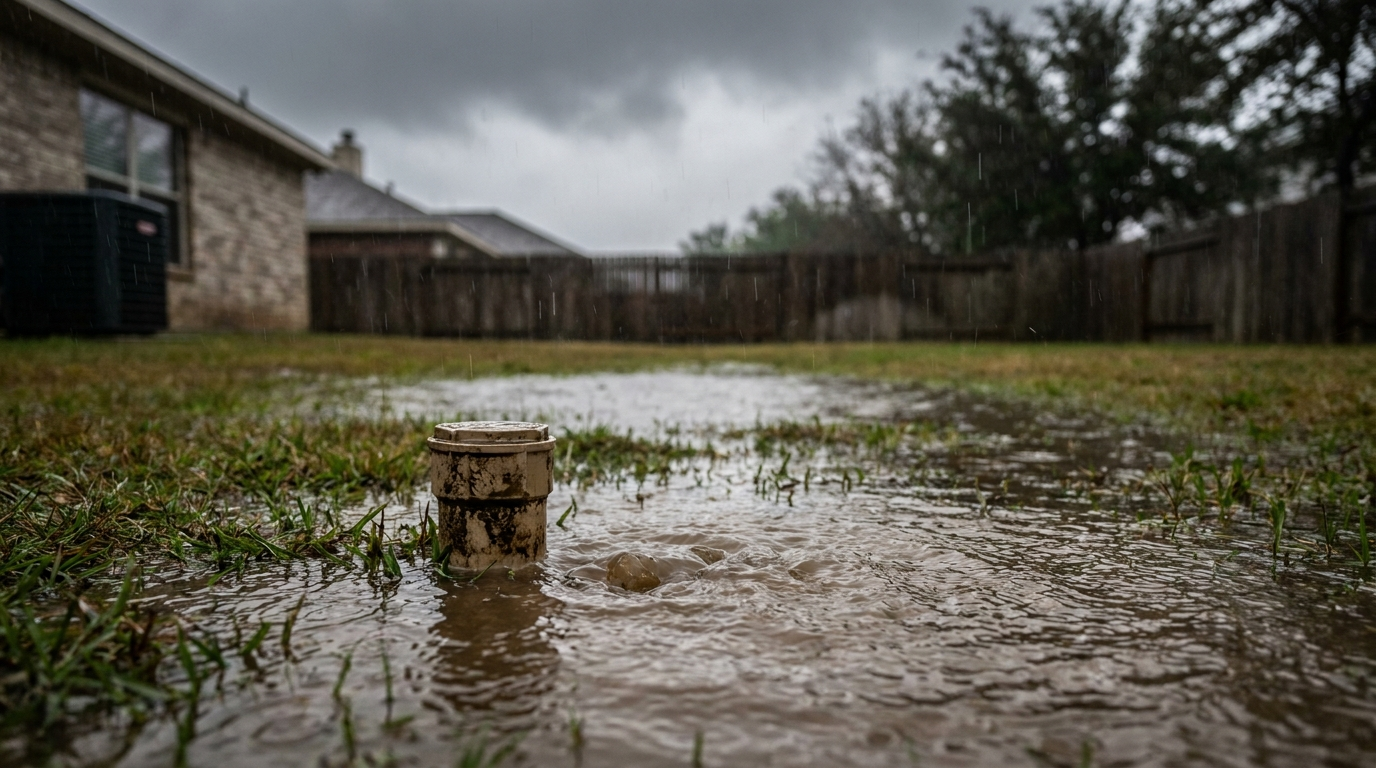
Missing or broken cleanout caps: An open cleanout at ground level acts like a funnel, feeding surface runoff directly into the line.
Root-cracked pipe: Tree and shrub roots chase moisture, wedge into hairline cracks, and pry them wide open.
Failed joints: Older clay and cast iron laterals have joints every few feet, and each one loosens as the ground moves.
Offset or bellied sections: Soil movement drops or misaligns a length of pipe, creating a gap where water pours in.
Missing or broken cleanout caps: An open cleanout at ground level acts like a funnel, feeding surface runoff directly into the line.
When rain saturates the ground, water pressure around the pipe rises and pushes through every one of these openings at once. That is why a line can run fine for weeks, then back up within an hour of a hard storm.
What are the signs your line is taking on stormwater?
The clearest sign is a backup that appears only during or right after heavy rain, then clears once the ground dries out. A clog behaves the same in any weather, but a line taking on stormwater reacts to the sky. Watch for:
Toilets or floor drains that gurgle or back up only in wet weather.
Drains that run normally on dry days but slow to a crawl during a storm.
Soggy spots or pooling in the yard along the sewer line’s path.
Toilets or floor drains that gurgle or back up only in wet weather.
Drains that run normally on dry days but slow to a crawl during a storm.
Soggy spots or pooling in the yard along the sewer line’s path.
If those patterns sound familiar, our companion guide on why your sewer backs up when it rains walks through the wet-weather symptoms in more detail. This post stays focused on the storm-system connection and how to seal it.
How does a camera inspection find infiltration points?
A sewer camera inspection finds infiltration by sending a waterproof video camera through the line so a technician can see exactly where water is entering. On the screen, active infiltration shows up as water weeping, dripping, or spraying through a crack, joint, or root intrusion, even between rain events. This is the only reliable way to separate a simple blockage from a pipe that is taking on stormwater.
The camera also measures how far the defect sits from the cleanout and how severe it is, which decides the repair. You can see what the process looks like in our overview of a sewer camera inspection in Colorado Springs. Without a camera, crews are guessing, and guessing usually means unnecessary digging.
How does trenchless CIPP lining seal out infiltration?
Trenchless CIPP lining seals out infiltration by creating a new, jointless pipe inside your old one. CIPP stands for cured-in-place pipe. A resin-saturated liner is pulled into the existing lateral, inflated against the pipe wall, and cured hard. Because the finished liner is continuous with no joints, the cracks, root openings, and loose connections that let stormwater in are sealed off from the inside.
For Colorado homeowners this has real advantages. The work is done through existing cleanouts or a small access point, so your lawn, driveway, and mature trees stay intact. Our residential trenchless pipelining seals the line, which also blocks the roots that keep returning to any remaining crack.
Sealing the lateral is also smart timing before cold weather. Water entering a cracked pipe can freeze and expand the damage, which is one reason we recommend preparing your sewer line for a Colorado winter after any wet-season repair.
Frequently Asked Questions
Is stormwater in the sewer my responsibility or the city’s?
The private sewer lateral, from your home to the connection at the city main, is almost always the homeowner’s responsibility in Colorado, and that is where most storm-related infiltration happens. The city maintains the public main and the storm system. If rain is getting into your line through a cracked or improperly connected lateral, fixing it falls to you. A camera inspection confirms whether the defect is on your side or near the public connection.
Can a backwater valve stop storm backups?
A backwater valve can stop sewage from flowing back into your home through the drains, but it does not stop stormwater from entering the pipe in the first place. The valve is a one-way gate near the outlet of your line. It is a valuable layer of protection against backups, yet if inflow and infiltration are overwhelming your lateral, you still need to seal the openings with lining to solve the root cause rather than just block the return flow.
Does disconnecting my downspouts or sump pump help?
Yes. If a downspout, gutter drain, or sump pump is tied into your sanitary sewer, redirecting it to drain onto the yard or into the proper storm system removes a direct source of inflow. This is often the single fastest way to cut the volume of stormwater reaching your line, and it pairs well with lining any cracks that let groundwater infiltrate.
Get your line inspected before the next storm
If your backups follow the weather, the fix starts with seeing inside the pipe. Alphalete Trenchless offers a free camera inspection and estimate for Colorado Springs and Denver metro homeowners, so you know exactly where stormwater is entering before you spend a dollar on repairs. Schedule your free camera inspection and find out whether trenchless lining can seal your line for good.